


Melbourne vs Geelong: Cost of Living and Lifestyle Differences
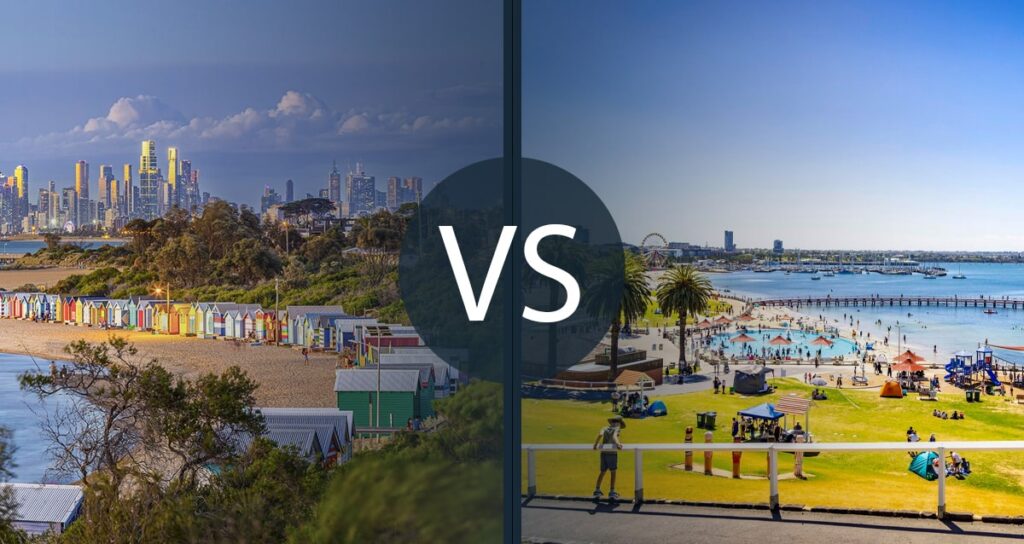

Melbourne and Geelong sit just over an hour apart, yet the cost of setting up a life in each is a different equation. Melbourne buys you the biggest job market and culture calendar in the state. Geelong buys you the coast, more house for your money, and a rent bill that is meaningfully lower.
As removalists in Melbourne, we move families in both directions every week, and right across the state as Victorian removalists. So this guide puts the two cities side by side on the numbers that actually change your budget: rent, house prices, transport, groceries, and the day-to-day extras. Every figure below is sourced and dated, so you can plan the move instead of guessing.
Quick answer
Geelong is cheaper to live in than Melbourne on almost every line item. Overall costs run about 24% lower in Geelong (Expatistan, Mar 2026), groceries about 10% lower and restaurants about 5% lower (Numbeo, Jul 2026). The biggest gap is housing: Greater Geelong’s median house rent is $500 a week versus a Melbourne house asking rent of $590 (Domain, March 2026 quarter), and Geelong’s median house price sits below Melbourne’s $991,500 (REIV, March 2026 quarter). Melbourne wins back ground on transport, jobs, and everyday variety. If you commute to the CBD, the Geelong line runs 50 to 65 minutes each way.
Melbourne vs Geelong: the 2026 snapshot
Melbourne is the capital: roughly 5.3 million people, the deepest labour market in Victoria, and the events that fill the calendar (Australian Open, the Grand Prix, the AFL Grand Final). Geelong is Victoria’s largest regional city and one of its fastest growing, adding about 7,600 residents a year at a 2.7% annual rate, well above the state’s 1.8% (id.community / ABS Regional Population). It is a different pattern to the fastest-growing suburbs in Melbourne, where the pressure sits on the city fringe.
That growth is the headline for anyone weighing the move. Greater Geelong passed 299,700 residents in 2025 and is forecast to reach about 442,000 by 2046 (City of Greater Geelong forecast). More people means more services, more competition for rentals, and steady pressure on prices, so today’s gap with Melbourne may narrow over time. For the wider backdrop, our guide to the cost of living in Australia tracks how both cities sit against the national trend.
Here is the at-a-glance comparison. The detail behind each row follows in its own section.
| Measure | Melbourne | Geelong | Who is cheaper |
|---|---|---|---|
| Median house rent (weekly) | $590 | $500 | Geelong |
| Median unit rent (weekly) | $600 | $410 | Geelong |
| Median house price | $991,500 | $871,000 | Geelong |
| Groceries (basket) | Base | ~10% lower | Geelong |
| Daily public transport cap | $11.40 (myki) | $11.40 (myki) | Tie |
| CBD job access | On the doorstep | 50 to 65 min by train | Melbourne |
Sources: Domain Rental Report (March 2026 quarter), REIV median house price (March 2026 quarter), CoreLogic Geelong 3220 (2026), Numbeo (Jul 2026), Transport Victoria myki fares (2026). Melbourne unit rent is Domain’s March 2026 quarter asking rent (a record high).
Melbourne vs Geelong: cost of living

The clearest way to size the gap is the like-for-like index. To hold the same standard of living, you would need about A$8,088 a month in Geelong against A$10,000 in Melbourne, assuming you rent in both (Numbeo, Jul 2026). That is roughly A$1,900 a month kept in your pocket, driven mostly by housing. The gap is narrower than a capital-to-capital jump like Melbourne versus Sydney, but it lands every single week.
Rent is where a move pays off first, because it hits every week from day one. Greater Geelong’s median asking rents sit well below Melbourne’s, and the unit gap is the widest of all.
Median weekly asking rent, houses
Domain Rental Report (Melbourne, March 2026 quarter) and CoreLogic / htag (Greater Geelong, 2026). Bar length scaled to Melbourne = 100%.
Renting a house in Geelong saves about $90 a week, or roughly $4,680 a year, before you factor in the unit market where the gap is larger still. Two caveats worth printing: inner Geelong (postcode 3220) runs hotter than the wider council area, with house rents nearer $588 a week (CoreLogic), and Geelong’s vacancy rate is tight at around 1.4% (SQM Research), so good listings move fast.
| Rental type | Melbourne (weekly) | Geelong (weekly) | Geelong saving |
|---|---|---|---|
| Median house | $590 | $500 | $90 / wk |
| Median unit | $600 | $410 | $190 / wk |
| Room in a share house | $220 to $300 | $150 to $220 | ~$70 / wk |
Sources: Domain Rental Report (Melbourne houses/units, March 2026 quarter, asking rents); htag / CoreLogic (Greater Geelong medians, 2026). Share-house ranges are indicative market listings.
Melbourne rents are still climbing, though the pace has cooled. Domain and SQM Research both forecast Melbourne rent growth of 2% to 5% across 2026, down from 6.1% in 2025 (DFFH). We unpack that pressure in our look at the Melbourne rental crisis, and the direction of travel keeps the Geelong discount attractive for renters on a fixed budget.
Buying: house prices and the deposit gap
For buyers the story is similar but with smaller percentage gaps than rent. Melbourne’s median house price hit $991,500 in the March 2026 quarter, up 1.9% for the quarter and 7.7% year on year (REIV). Geelong’s median house sits around $871,000 (CoreLogic, postcode 3220), with the broader Greater Geelong figure near $911,820 (htag).
| Metric | Melbourne | Geelong |
|---|---|---|
| Median house price | $991,500 | $871,000 |
| Quarterly change | +1.9% | roughly flat (+0.1% YoY) |
| Indicative 20% deposit | $198,300 | $174,200 |
| Gross rental yield | ~3.1% | ~3.0% |
Sources: REIV median house price (Melbourne, March 2026 quarter); CoreLogic (Geelong 3220, 2026); htag (Greater Geelong, including the gross rental yield). Deposit figures are 20% of the median and exclude stamp duty and fees.
The buyer takeaway: Geelong shaves roughly $120,000 off the median house price and about $24,000 off a 20% deposit, while Melbourne’s market is running warmer this year. Regional Victoria as a whole set a record median of $672,000 in the March 2026 quarter (REIV), so the days of Geelong being a “cheap” regional option are fading even if it still undercuts the capital. At the other end of the scale, Melbourne’s dearest pockets sit far higher again, as our guide to the richest suburbs in Melbourne shows.
Groceries, dining and everyday spending
Beyond housing, the weekly shop and eating out both lean Geelong’s way, though by single digits rather than the double-digit rent gap. Groceries run about 10.3% lower and restaurants about 4.6% lower in Geelong (Numbeo, Jul 2026). Utilities, phone and internet are close to level across the two.
| Everyday item | Melbourne | Geelong |
|---|---|---|
| Groceries basket (index) | Base | 10.3% lower |
| Restaurant meals (index) | Base | 4.6% lower |
| Inexpensive meal out | ~$25 | ~$24 |
| Domestic beer (0.5L, pub) | ~$12.00 | ~$9.50 |
| Basic utilities (85m2 home) | ~$222 / mo | ~$218 / mo |
Source: Numbeo cost of living comparison, Melbourne vs Geelong (Jul 2026). Index rows are Numbeo category differences; dollar rows are indicative crowd-sourced prices and move with brand and venue.
A single person can expect a weekly grocery bill of roughly $50 to $100 in either city (Numbeo), so the practical saving in Geelong is a few dollars a week on food rather than a budget-changer. The real money is still in rent and the mortgage.
Melbourne vs Geelong: transport and the commute
This is the section where Melbourne closes the gap. Inside Melbourne you are rarely far from a train, tram or bus, and everything runs on one myki. From Geelong, the trade-off for cheaper housing is a commute if your job is in the CBD.
Good news for the budget: the Geelong line is part of the myki network, so a Geelong to Melbourne commuter pays the same daily cap as a metro traveller rather than a pricier regional fare. The full-fare daily cap is $11.40 and the two-hour fare is $5.70 from 1 January 2026 (Transport Victoria).
| Transport measure | Melbourne | Geelong |
|---|---|---|
| Two-hour fare (full) | $5.70 | $5.70 |
| Daily cap (full) | $11.40 | $11.40 |
| Train time to Melbourne CBD | n/a (local) | 50 to 65 min |
| Petrol (1L, unleaded) | ~$1.91 | ~$1.82 |
Sources: Transport Victoria myki fares (from 1 January 2026); V/Line Geelong line timetable (fastest to slower service). Fuel prices are indicative and change daily.
Two timely notes. Public transport across Victoria is running at half price from 1 June 2026 until 1 January 2027, which drops the daily cap to $5.70 for the second half of the year (Transport Victoria). And a car is more of a must in Geelong for anything off the train line, so factor fuel and a second car into a Geelong budget even with petrol a few cents cheaper per litre. Our fuel cost calculator puts a real number on the weekly commute.
If your work is fully remote or Geelong-based, Melbourne’s transport edge barely matters and the housing saving wins outright. If you are tied to a CBD desk five days a week, price the commute honestly: 50 to 65 minutes each way is real time, even at a low fare. A halfway option some buyers weigh is a suburb further down the same line, such as Werribee, which trims the trip without paying inner-city prices.
Lifestyle, jobs and the trade-offs
Numbers decide the budget, but lifestyle decides whether you stay. Melbourne and Geelong pull in different directions here, and the right answer depends on the life stage you are moving for.
Melbourne strengths: the deepest job market in Victoria, the widest culture and dining scene, major sport and events, and no commute if you work in the inner city. Our rundown of the best suburbs in Melbourne weighs that lifestyle against price. The cost is higher rent, higher prices, and more crowding.
Geelong strengths: lower housing costs, the bay and the surf coast on your doorstep, a genuine community feel, and fast-growing services as the population climbs. The cost is a thinner job market, fewer late-night options, and a commute if your work stays in Melbourne.
Geelong’s growth is also concentrated in specific pockets, which matters when you pick where to land. The fastest-growing areas in recent ABS data are Barwon Heads and Armstrong Creek (+1,093 residents in a single year), Charlemont (+868) and Grovedale and Mount Duneed (+833), with Armstrong Creek ranked among the largest-growing districts in Australia outside the capital cities (ABS Regional Population). New estates there give you a near-new home at a lower price than an equivalent Melbourne growth suburb, though the trade-off is a longer drive to the station and to Geelong’s centre.
| Factor | Melbourne | Geelong |
|---|---|---|
| Job market | Deepest in the state | Growing but smaller |
| Housing cost | Higher | Lower |
| Coast and open space | Bay beaches, further out | Bay + surf coast close |
| Nightlife and events | World-class calendar | Quieter, growing |
| Commute to CBD jobs | Short | 50 to 65 min train |
A practical summary of the trade-offs rather than a single-source dataset; housing and commute rows reflect the figures above.
A simple decision rule. If your priority is career options and city life, Melbourne earns its premium, and our moving to Melbourne guide walks through the practicalities. If your priority is a bigger home, lower weekly outgoings and the coast, Geelong wins, and it wins hardest if you do not need to commute to the CBD five days a week.
Where to live: Melbourne and Geelong areas
Both cities are really a set of very different neighbourhoods, and where you land changes your budget as much as the city choice. We move into all of these, so here is a quick orientation, starting with Melbourne.
Kensington and Bentleigh sit in the sweet spot: inner or middle-ring access without the top-end price tag, popular with families and first-home buyers.
Richmond and Northcote are the lifestyle picks, close to the CBD with strong cafe and transport links, and rents to match.
Mount Waverley and the eastern suburbs trade a longer commute for bigger blocks and well-regarded schools, popular with buyers who want space without leaving the metro network.
Geelong splits along similar lines, from blue-chip inner suburbs to value pockets and the coast.
Newtown and Highton are the blue-chip choices, with period homes, leafy streets and the region’s strongest prices.
Belmont and the northern suburbs offer steadier value and are where a lot of first-home buyers start.
Ocean Grove and Torquay carry a lifestyle premium for beach access, so you pay more for less house than you would inland. Our guide to the best suburbs in Geelong breaks down each one in detail.
Prefer to weigh Geelong against another regional option, or Melbourne against a bigger capital? Compare Melbourne vs Bendigo and living in Melbourne vs Sydney for the wider picture before you settle on a suburb.
What a Melbourne to Geelong move actually costs
Once you have chosen, the move itself is the last budget line, and it is smaller than most people expect because Geelong is a regional Victoria move, not an interstate one. There is no border, no long-haul freight, and no overnight leg.
Melbourne removalists charge roughly $114 to $190 an hour for two movers and a truck (Airtasker, 2026). A Melbourne to Geelong run adds travel time and a fuel component, but a typical whole-home move still lands well under an interstate price.
| Home size | Typical crew | Indicative Melbourne to Geelong cost |
|---|---|---|
| 1 to 2 bedroom unit | 2 movers + truck | $800 to $1,500 |
| 3 bedroom house | 3 movers + truck | $1,500 to $2,500 |
| 4+ bedroom house | 3 to 4 movers + truck | $2,200 to $3,200 |
Indicative ranges built from Airtasker 2026 hourly rates and regional-move travel loadings. Your quote depends on volume, access, stairs, and date.
Two ways to trim the bill. First, cut volume: fewer boxes and less furniture means fewer hours, and our packing calculator estimates what you will need. Second, plan the timeline: the moving house checklist keeps the run tight so you are not paying for a slow, disorganised load day.
Ready to move between Melbourne and Geelong?
Whichever way you are heading, the sums favour a planned move over a rushed one. We run this corridor constantly, both the Melbourne to Geelong sea-change and the Geelong to Melbourne move for work, so we know the access quirks at both ends: tight inner-Melbourne parking and permits, and the longer regional leg to Geelong. See how the price works for your home with our guide to removalist cost in Melbourne.
Or handle the whole regional Victoria run in one booking through our Melbourne to Geelong removals service. When you are ready for a firm figure, get an instant removalist quote in a couple of minutes.
Frequently asked questions about Melbourne vs Geelong cost of living
Is Geelong cheaper to live in than Melbourne?
Yes. Overall living costs run about 24% lower in Geelong (Expatistan, Mar 2026), led by housing. Greater Geelong’s median house rent is $500 a week against $590 in Melbourne, and groceries are about 10% cheaper (Numbeo, Jul 2026).
How much cheaper is rent in Geelong?
Renting a house in Geelong saves about $90 a week, or roughly $4,680 a year, versus Melbourne ($500 vs $590 median asking rent). The unit gap is wider at about $190 a week (Domain and CoreLogic, 2026).
What is the median house price in Geelong versus Melbourne?
Geelong’s median house price is around $871,000 (CoreLogic, postcode 3220, 2026), roughly $120,000 below Melbourne’s $991,500 for the March 2026 quarter (REIV). Broader Greater Geelong sits near $911,820.
How long is the commute from Geelong to Melbourne?
The V/Line Geelong line runs 50 to 65 minutes to Melbourne, depending on how many stops the service makes. The fastest express trains do it in about 50 minutes.
Does the Geelong train cost more than a Melbourne fare?
No. The Geelong line is on the myki network, so commuters pay the standard $11.40 daily cap, not a regional fare (Transport Victoria, 2026). Victoria-wide half-price fares also apply from 1 June 2026 to 1 January 2027.
Is Geelong a good place to move for families?
Often yes. Families get more house for their money, coast access, and a fast-growing city adding about 7,600 residents a year (id.community). The main trade-off is a smaller job market and a commute if work stays in Melbourne.
How much does it cost to move from Melbourne to Geelong?
A 3-bedroom house typically costs $1,500 to $2,500, and a small unit $800 to $1,500. It is a regional Victoria move, not interstate, so it is far cheaper than a cross-border relocation. Get an exact figure with our instant quote.
Are groceries and dining really cheaper in Geelong?
Yes, but modestly. Groceries are about 10.3% lower and restaurant meals about 4.6% lower than Melbourne (Numbeo, Jul 2026). For a single person that is a few dollars a week on food, so the big savings stay in rent and mortgage.
Sources (verified 4 July 2026):
• Domain Rental Report, March 2026 quarter (Melbourne house and unit asking rents): domain.com.au
• Real Estate Institute of Victoria, median house price March 2026 quarter (Melbourne, regional Victoria): reiv.com.au
• Greater Geelong City property market and house prices 2026 (medians, rent, yield): htag.com.au
• Numbeo cost of living comparison, Melbourne vs Geelong (Jul 2026): numbeo.com
• Expatistan cost of living comparison, Melbourne vs Geelong (Mar 2026): expatistan.com
• Transport Victoria, metropolitan and myki fares 2026: transport.vic.gov.au
• V/Line Geelong line timetable and travel times: vline.com.au
• City of Greater Geelong population forecast (id.community): forecast.id.com.au
• ABS Regional Population 2024-25 (Geelong growth): abs.gov.au
• Airtasker, how much removalists cost in Australia (2026): airtasker.com
Last updated: 4 July 2026. Property and rent medians shift each quarter; treat dollar figures as a guide and confirm current listings before you move.
Why North Removals
Explore our services and uncover the essence of North Removals in Melbourne: our unwavering dedication to top-tier customer service, timely updates, and the unparalleled expertise of our seasoned team.

Competive Rates

99% On-Time Delivery

5-Star Service

Top Customer Service
Get a Quick Quote Now
------------------------------------------------------ Complete the form below to get a customised quote tailored to your needs.